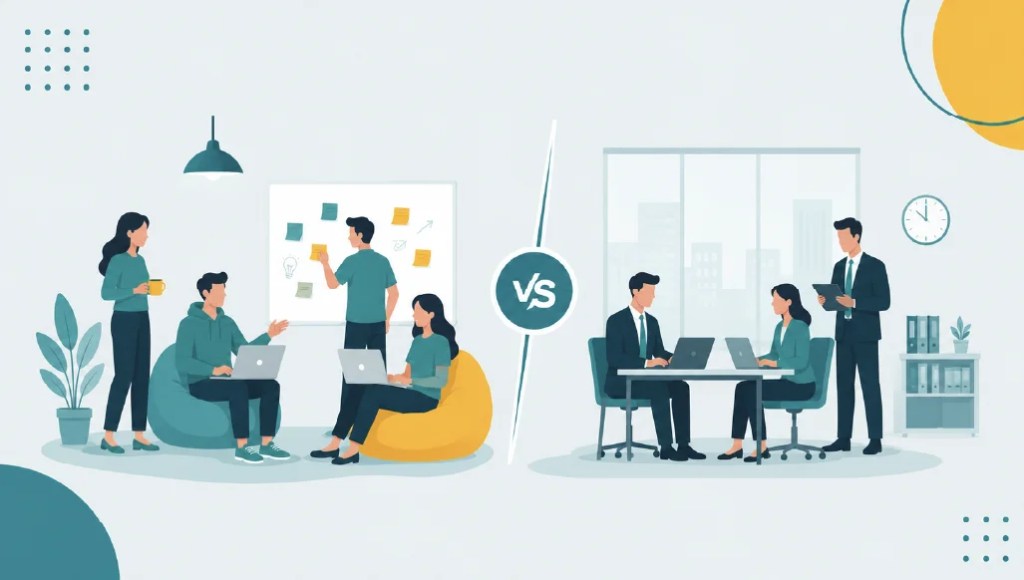
Choosing between startup work culture and a traditional corporate workplace isn’t just about company size. It shapes how employees communicate, solve problems, feel recognized, and stay engaged. For HR leaders in manufacturing, retail, and healthcare, understanding these differences is key to building an organizational culture that drives employee engagement.
Key Takeaways
- Startup and corporate cultures offer different employee experiences.
- Recognition should match workplace culture rather than follow a one-size-fits-all approach.
- Flexibility and structure can successfully coexist.
- Digital recognition platforms help organizations personalize engagement at scale.
- HR leaders should combine the strengths of both cultures to improve retention and productivity.
What is Startup Work Culture and How is it Different?
Startup work culture focuses on flexibility, speed, collaboration, and ownership. A corporate work environment emphasizes consistency, defined processes, and operational stability.
Startup Work Culture
Startups typically run with smaller teams, shifting priorities, and few layers of management. Employees often wear multiple hats and take on work beyond their job description. Decisions happen fast, experimentation is encouraged, and innovation becomes part of everyday work.
Common characteristics include:
- Faster decision-making
- Flexible responsibilities
- Informal communication
- Greater autonomy
- Rapid adaptation to change
Corporate Work Environment
A corporate work environment is built for scale. Processes help maintain quality, compliance, and consistency across departments and locations, especially important in industries like manufacturing, healthcare, and retail.
Corporate organizations often provide:
- Clearly defined roles
- Standard operating procedures
- Formal recognition systems
- Structured career progression
- Predictable workflows
Rather than choosing one model over the other, many organizations benefit from combining startup agility with corporate discipline.
8 Key Differences Between Startup and Corporate Culture
The biggest differences show up in decision-making, communication, recognition, career growth, and employee autonomy. Understanding them helps HR teams design more relevant engagement strategies.
1. Decision-Making Happens Faster in Startups
Startup teams often make decisions within hours because there are fewer layers of approval.
Corporate organizations typically involve multiple stakeholders to reduce risk and ensure consistency.
Engagement takeaway:
- Empower frontline managers with limited decision-making authority.
- Reduce unnecessary approval delays for recognition initiatives.
2. Employees Wear Multiple Hats
One of the most discussed pros and cons of startup jobs is role flexibility.
Employees often handle responsibilities outside their job title, which creates broader learning opportunities but also adds to the workload.
Corporate roles tend to be more specialized, allowing employees to develop deep expertise.
Engagement takeaway:
Recognition should celebrate both collaboration and adaptability, especially when employees step outside their standard responsibilities.
3. Recognition Looks Different
Recognition in startups often happens spontaneously.
Examples include:
- Public appreciation during team meetings
- Peer shout-outs
- Instant rewards
- Informal celebrations
Corporate organizations usually rely on structured recognition programs that ensure fairness across larger workforces.
Digital recognition platforms, including solutions from AdvantageClub.ai, help organizations build a stronger culture of recognition that combines consistency with timely appreciation, regardless of workforce size.
4. Innovation vs. Process
Startups encourage experimentation because speed is often a competitive advantage. Corporate organizations prioritize repeatable processes to maintain quality, safety, and compliance.
This matters most in healthcare and manufacturing, where standardized procedures protect employees and customers alike. The most effective engagement strategies encourage innovation while respecting operational requirements.
5. Career Growth Takes Different Paths
Employees considering choosing between startup and corporate job opportunities frequently compare career development.
In startups, growth often comes through expanded responsibilities and leadership opportunities.
Corporate organizations typically offer:
- Defined career pathways
- Promotion criteria
- Role specialization
- Long-term organizational mobility
HR teams should recognize achievements in both formal promotions and everyday contributions; that’s what keeps employees motivated regardless of structure, reinforcing the importance of employee recognition at every career stage.
6. Communication Styles Shape Employee Experience
Communication in startups is usually informal and direct, while corporate organizations rely on structured channels to ensure consistency across larger teams.
Startup employees often talk directly with founders or senior leaders, so ideas move fast. Larger organizations rely on established communication processes to manage geographically dispersed teams and multiple business units.
Engagement takeaway:
Blend both approaches by:
- Sharing company updates through digital communication channels.
- Encouraging two-way feedback between employees and managers.
- Giving frontline supervisors simple tools to recognize achievements in real time.
- Creating opportunities for employees to share ideas regardless of hierarchy.
7. Employee Well-Being Is Approached Differently
Startups often emphasize flexibility, while corporations typically offer broader well-being programs backed by established policies.
Regardless of size, today’s workforce expects employers to care about more than productivity. Manufacturing workers, retail associates, and healthcare professionals all value recognition, flexibility where possible, and support for their overall work experience.
Engagement takeaway:
A balanced well-being strategy should include:
- Flexible recognition options
- Regular employee feedback
- Wellness initiatives
- Peer appreciation
- Manager recognition
- Celebrating team milestones
8. Technology Adoption Happens at Different Speeds
Startups typically adopt new workplace technologies quickly because fewer systems need to be integrated. Large enterprises often move more carefully, evaluating scalability, security, and compliance before implementation.
However, modern employee engagement technology allows organizations of every size to personalize recognition without adding administrative burden. The goal isn’t to adopt technology for its own sake—it’s to make appreciation timely, meaningful, and accessible across every location.
How to Choose the Right Engagement Strategy for Your Workplace
The best engagement strategy reflects your organization’s culture while borrowing strengths from both startup and corporate models.
Step 1: Understand Employee Expectations
Gather regular feedback from different workforce segments.
Ask questions such as:
- What motivates employees?
- How do they prefer to be recognized?
- Which workplace challenges affect engagement most?
Listening first helps HR managers avoid one-size-fits-all programs.
Step 2: Segment Your Workforce
Different employee groups often have different needs.
For example:
- Manufacturing teams may value shift-based recognition.
- Retail associates appreciate instant appreciation for customer service.
- Healthcare professionals often respond well to peer recognition and milestone celebrations.
Personalization improves relevance without sacrificing consistency.
Step 3: Build Flexible Recognition Programs
Effective programs combine structure with flexibility.
Consider including:
- Peer-to-peer recognition
- Manager awards
- Milestone celebrations
- Team achievements
- Digital rewards
- Wellness recognition
This approach works well across both startup-inspired and corporate cultures.
Step 4: Measure, Learn, and Improve
Monitor engagement continuously rather than relying on annual reviews.
Track indicators such as:
- Recognition participation
- Employee feedback
- Manager involvement
- Retention trends
- Team morale
Small improvements made consistently often produce stronger long-term results, the same compounding effect that builds a compelling employer brand over time.
Engagement Impact & Value: Startup vs. Corporate Culture
|
Impact Dimension |
Startup Culture |
Corporate Culture |
|
Speed of Impact |
• Recognition felt almost immediately • Morale shifts visible within days • Quick wins build momentum fast |
• Impact builds gradually through consistent cadence • Takes longer to see culture-wide shifts • Sustained programs compound over quarters |
|
Retention Value |
• High-growth opportunities offset uncertainty • Ownership/equity can anchor loyalty • Risk: burnout from role overload reduces long-term retention |
• Structured career paths reduce flight risk • Predictable recognition builds long-tenure loyalty • Risk: lack of novelty can quietly erode engagement |
|
Cost-Efficiency |
• Low-cost, high-frequency recognition (shout-outs, informal rewards) • Limited budget for large-scale programs |
• Higher upfront investment in platforms/programs • Cost spread across a larger workforce lowers per-employee spend |
|
Scalability of Impact |
• Hard to scale beyond small teams without losing authenticity • Founder-driven recognition doesn’t scale past a certain headcount |
• Built to scale across departments, shifts, and geographies • Digital platforms extend consistent impact org-wide |
|
Measurability of ROI |
• Often informal, harder to quantify • Engagement tracked through pulse or anecdotal feedback |
• Formal dashboards and metrics tie engagement to retention/productivity • Easier to build a business case from data |
|
Risk if Engagement Fails |
• Small teams mean one disengaged employee has outsized impact • Attrition can stall entire projects |
• Disengagement can spread silently across large teams before detection • Slower to detect, costlier to reverse at scale |
Building a Culture That Fits Your Business
Neither startup agility nor corporate structure is a universal fix; the strongest organizations blend both, adapting recognition, consistency, and well-being to real employee expectations. AI makes this easier: it helps HR teams deliver personalized, timely recognition at scale without losing the human touch. Sentiment insights, engagement dashboards, and smart recommendations free up managers to focus on genuine connection instead of admin work. For HR leaders in manufacturing, retail, and healthcare, that means appreciation that feels personal at every level, built on a genuine appreciation culture at work, not a generic point system bolted onto either model. Platforms like AdvantageClub.ai help HR teams put that kind of culture into practice without adding to their workload.
What is startup work culture?
Startup work culture emphasizes flexibility, collaboration, quick decision-making, and innovation. Employees often take on diverse responsibilities and adapt quickly as priorities shift.
Is a corporate work environment better than a startup?
Neither is better. A corporate work environment offers structure and stability, while startups provide greater agility and autonomy. The right fit depends on business needs and employee preferences.
What are the pros and cons of startup jobs?
Startup jobs offer broader responsibilities, faster growth, and greater ownership but may involve changing priorities and less predictable career paths.
How can HR leaders improve engagement across different workplace cultures?
HR leaders should personalize recognition, encourage continuous feedback, empower managers to promptly recognize achievements, and use digital engagement platforms to ensure consistent employee experiences.
 Advantage Club Blogs