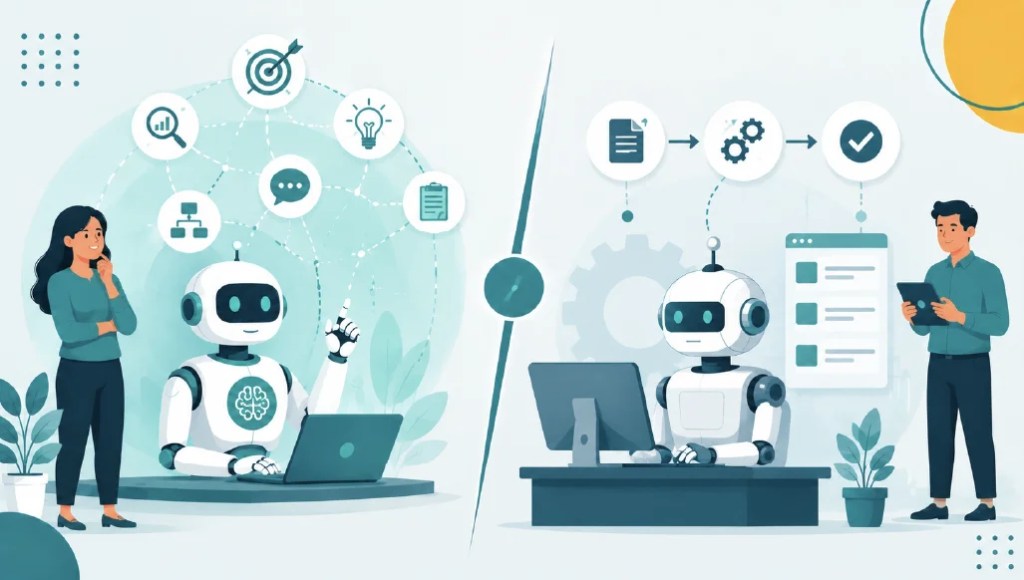
Organizations across manufacturing, retail, healthcare, and HR are accelerating automation, but not all automation is the same. Understanding agentic AI vs RPA is becoming essential for leaders deciding where to invest. While Robotic Process Automation (RPA) executes predefined workflows, agentic AI evaluates context, makes decisions, and adapts to changing conditions. Knowing when to use each technology improves operational efficiency, employee experience, and business agility.
Key Takeaways
- Agentic AI makes context-aware decisions, while RPA follows predefined rules.
- RPA is ideal for repetitive, structured tasks.
- Agentic AI adapts to changing business conditions with minimal intervention.
- Many organizations achieve the best outcomes by combining both technologies.
- Manufacturing, retail, healthcare, and HR can all benefit from intelligent automation.
Agentic AI vs Traditional Automation: What Makes Agentic AI Different?
Agentic AI is designed to understand goals, assess information, make decisions, and take action with minimal human input. In agentic AI vs traditional automation, RPA and other traditional automation follow predefined rules and cannot adapt to unexpected changes.
What is agentic AI?
To understand what agentic AI is, it helps to know that it focuses on achieving goals rather than simply following programmed instructions. It evaluates information, decides what to do next, and takes action within the rules set by the business.
Key characteristics include:
- Goal-oriented decision-making
- Context awareness
- Ability to plan multiple actions
- Continuous adaptation as conditions change
- Human collaboration when approvals are needed
Rather than waiting for every instruction, agentic AI determines the best path to achieve a desired outcome while remaining within business policies that support responsible AI adoption.
What is RPA?
Robotic Process Automation uses software bots to automate repetitive, rules-based processes.
RPA works best when workflows involve:
- Structured data
- Predictable business rules
- Repetitive administrative tasks
- High-volume processing
- Minimal exceptions
For example, an RPA bot can move data between systems or generate standard reports. If something unexpected happens, it follows predefined rules instead of deciding what to do next.
This distinction highlights the core difference in agentic AI vs traditional automation: traditional automation follows instructions, while agentic AI evaluates situations before acting.
Agentic AI vs RPA: 7 Key Differences Every Business Should Understand
The comparison below highlights how each approaches decision-making, adaptability, data processing, and long-term business value.
|
Difference |
RPA |
Agentic AI |
Business Implication |
|
Decision-making |
Executes predefined rules exactly as programmed |
Evaluates variables and determines the best action |
HR teams can surface recognition opportunities, not just scheduled reminders |
|
Adaptability |
Requires reconfiguration when processes change |
Interprets new information and adjusts automatically |
Faster response to operational or workforce disruptions |
|
Data handling |
Works best with structured, predefined formats |
Analyzes emails, documents, feedback, & conversations |
A broader range of business applications |
|
Learning |
Repeats the same workflow until manually updated |
Improves recommendations from feedback and outcomes |
Continuous process optimization over time |
|
Human collaboration |
Completes assigned tasks only |
Provides recommendations while humans decide |
Supports employees rather than replacing them |
|
Scalability |
Efficient for repetitive tasks, harder with exceptions |
Coordinates across systems, adjusts to priorities |
Better suited to complex, evolving operations |
|
Long-term value |
Improves operational efficiency |
Improves decision speed, experience, and agility |
Efficiency plus adaptability, not efficiency alone |
How Do You Decide Between Agentic AI and RPA?
When evaluating RPA vs AI agents, start by understanding whether your processes require execution, decision-making, or both.
Step 1: Identify repetitive workflows
Start by listing routine, rule-based tasks that take up employee time, such as data transfers, invoice processing, report generation, and system updates. These are often good candidates for RPA.
Step 2: Evaluate decision-heavy and unstructured processes
Next, look at processes that require employees to review information before making a decision. This could include employee engagement recommendations, customer issue prioritization, workforce planning, or operational scheduling, especially when work involves documents, conversations, or changing conditions. These are better suited to agentic AI.
Step 3: Focus on employee experience
The goal of automation isn’t simply to replace manual work; it’s to free employees to focus on higher-value activities that require creativity, collaboration, and strategic thinking. For HR teams, that might mean using AI for managers to recommend timely employee recognition instead of manually reviewing engagement signals.
Step 4: Build a hybrid automation strategy
Many organizations evaluating RPA vs AI agents achieve the best results by combining both technologies. RPA takes care of repetitive tasks, while agentic AI supports planning, recommendations, and decision-making.
Where Agentic AI Delivers the Greatest Business Value
The difference between automation and agentic AI is most apparent where employees must make informed decisions while keeping operations efficient.
Manufacturing
Manufacturers can use agentic AI to support production planning, optimize maintenance scheduling, identify bottlenecks, and recommend corrective actions before disruptions affect operations.
Retail
Retailers can respond more quickly to changing demand with smarter inventory recommendations, more personalized customer experiences, and better operational decisions.
Healthcare
Healthcare providers can automate administrative coordination, improve scheduling, assist with documentation workflows, and help prioritize operational tasks while keeping healthcare professionals focused on patient care.
HR and Employee Engagement
HR leaders are increasingly adopting agentic AI in HR to strengthen employee engagement instead of simply automating administrative work. AdvantageClub.ai combines AI-powered recognition, rewards, and engagement capabilities to help managers recognize employees at meaningful moments and surface actionable workforce insights without increasing administrative effort.
When to Use RPA, Agentic AI, or Both
|
Business Scenario |
Best Fit |
Why |
|
Transferring data between systems |
RPA |
Structured, repetitive, rule-based |
|
Invoice or report processing at scale |
RPA |
High-volume, predictable, low exceptions |
|
Recommending timely employee recognition |
Agentic AI |
Requires context and judgment, not just triggers |
|
Prioritizing customer or patient issues |
Agentic AI |
Needs reasoning across unstructured inputs |
|
End-to-end HR engagement workflow |
Both |
RPA handles execution; agentic AI handles the decisions layered on top |
This scenario view is often more useful than a technology comparison alone. Most businesses don’t choose one system; they design a workflow where each technology does what it does best.
The Future of Business Automation Starts with the Right AI Strategy
Understanding agentic AI helps businesses choose the right technology instead of treating agentic AI and RPA as competing solutions. RPA excels at executing predictable, rules-based processes, while agentic AI adds intelligence, adaptability, and goal-oriented decision-making to complex workflows. Organizations that combine both technologies can automate routine work while empowering employees to make faster, more informed decisions. AdvantageClub.ai shows how intelligent automation can enhance employee recognition, engagement, and workplace productivity without increasing administrative effort.
What is the biggest difference between agentic AI and RPA?
The biggest difference between automation and agentic AI is how they make decisions. In an agentic AI vs RPA comparison, RPA follows predefined rules to complete repetitive tasks, while agentic AI evaluates information, adapts to changing situations, and decides on the best next step based on the goal.
Can businesses use RPA and AI agents together?
Yes. RPA vs AI agents isn’t always an either-or choice. Many organizations use RPA for repetitive, rules-based tasks and rely on AI agents for decision-making, exception handling, and recommendations. Using both together helps improve efficiency while making better use of existing automation.
Is agentic AI replacing traditional automation?
No. The discussion around agentic AI vs traditional automation is about choosing the right tool for the job, not replacing one with the other. Traditional automation remains effective for predictable workflows, while agentic AI is better suited to work that requires context, planning, and adaptability.
What is agentic AI, and which industries benefit most from it?
Agentic AI is a type of AI that can work toward a goal instead of simply following predefined instructions. Manufacturing, retail, healthcare, and HR use it to improve planning, experiences, and decision-making as business needs evolve.
 Advantage Club Blogs