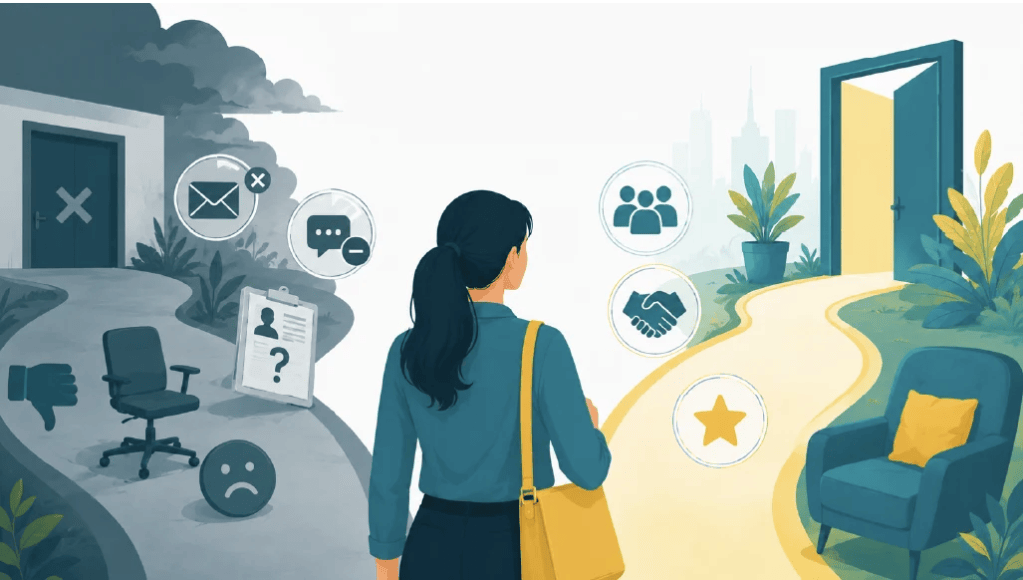
Hiring doesn’t start on day one; it starts the moment a candidate finds your company. Every touchpoint, from the application to the interview follow-up, shapes how they perceive your brand. For manufacturing, retail, and healthcare, employers managing high-volume hiring know that candidate experience is no longer optional.
Here are 8 common mistakes that quietly damage the employer brand, and how HR teams can fix them before they cost top talent.
Mistake #1: Slow Response Times That Signal Disinterest
Delayed responses tell candidates you’re either disorganized or uninterested; neither impression helps.
When applicants wait days or weeks for updates, many accept other offers before hearing back. Speed signals respect, and candidates notice when it’s missing.
What HR teams can do instead?
- Establish communication timelines.
- Send automated status updates.
- Inform candidates about expected decision dates.
- Train hiring managers to respond promptly.
Timely communication remains one of the most important best practices for the candidate experience.
Mistake #2: Complicated Application Processes
Long, confusing applications push candidates away, especially frontline workers applying from mobile devices between shifts.
This issue is especially significant for frontline workers who may be applying from mobile devices during breaks or after shifts.
Simple ways to remove friction
- Reduce duplicate data entry.
- Optimize applications for mobile devices.
- Limit mandatory fields to essential information.
- Allow resume-based applications where appropriate.
A simple application process communicates respect for candidates’ time.
Mistake #3: Poor Communication Throughout the Hiring Journey
Candidates value transparency, even when the answer is no. Leaving people in the dark is one of the most damaging mistakes in the candidate experience.
One of the biggest mistakes in candidate experience is leaving applicants uncertain about the next steps.
Communication candidate experience best practices
- Send interview confirmations promptly.
- Provide clear process expectations.
- Share timelines for decisions.
- Acknowledge delays honestly.
- Notify all candidates of final outcomes.
Consistent communication builds trust at every employee experience touchpoint, and that starts well before day one.
Mistake #4: Unprepared Interview Experiences
Interviewers who arrive late, ask repetitive questions, or haven’t reviewed a candidate’s background signal disorganization, and candidates walk away questioning whether the company is worth joining.
Creating consistency across hiring teams
- Develop structured interview guides.
- Train hiring managers regularly.
- Share candidate information before interviews.
- Align evaluation criteria across teams.
Strong interview experiences reinforce a positive employer brand candidate experience.
How Each Mistake Impacts Candidate Experience and Employer Brand
|
# |
Mistake |
Impact on Candidate Experience |
Impact on Employer Brand |
|
1 |
Slow Response Times |
Signals disinterest; candidates assume disorganization |
Loses qualified candidates to faster competitors |
|
2 |
Complicated Applications |
Increases frustration and mobile drop-off |
Suggests the org doesn’t value candidates’ time |
|
3 |
Poor Communication |
Leaves candidates uncertain about next steps |
Erodes trust before the relationship even starts |
|
4 |
Unprepared Interviews |
Feels disorganized and impersonal |
Raises doubts about the company’s professionalism |
|
5 |
Ignoring Feedback |
Misses recurring pain points in the hiring journey |
Signals indifference to candidate input |
|
6 |
Dismissing Rejected Candidates |
Leaves a negative final impression |
Loses future applicants, customers, and advocates |
|
7 |
Inauthentic Culture Messaging |
Creates mismatched expectations post-hire |
Damages long-term trust and credibility |
|
8 |
Over-Automating Without Human Touch |
Makes candidates feel like transactions |
Weakens perceived warmth of employer brand |
Mistake #5: Ignoring Candidate Feedback
Candidate feedback shows exactly where your hiring process breaks down. Most organizations collect it, but few act on it.
How to collect and act on insights
- Use short post-interview surveys.
- Track recurring complaints.
- Review candidate feedback quarterly.
- Implement visible process improvements.
Listening to candidates demonstrates a commitment to continuous improvement.
How to Improve Candidate Experience: A Step-by-Step Approach
Knowing how to improve candidate experience starts with mapping every touchpoint, not applying isolated fixes.
Step 1: Map the candidate journey
Document every touchpoint from application to hiring decision.
Step 2: Identify friction points
Review areas where candidates commonly drop out or express frustration.
Step 3: Automate routine communication
Use technology to provide timely updates while maintaining personalization.
Step 4: Measure and refine continuously
Track metrics such as response times, application completion rates, and candidate satisfaction scores.
This structured approach helps organizations strengthen candidate experience and employer perception over time.
Mistake #6: Treating Rejected Candidates as an Afterthought
Rejected candidates don’t disappear; they become future applicants, customers, or people who share their experience publicly.
Best practices include:
- Sending respectful rejection messages.
- Thanking candidates for their time.
- Providing constructive feedback when feasible.
- Encouraging future applications.
A thoughtful rejection process protects the employer brand and preserves relationships.
Mistake #7: Failing to Showcase Workplace Culture Authentically
Candidates want an accurate picture of your workplace before accepting an offer. Polished messaging that doesn’t match reality creates mismatched expectations and early attrition.
Authentic culture communication should include:
- Real employee stories.
- Transparent role expectations.
- Honest discussions about workplace challenges.
- Examples of recognition, well-being, and engagement initiatives.
Organizations using platforms like AdvantageClub.ai strengthen culture visibility through recognition and engagement programs that create authentic employee experiences worth sharing. That authenticity extends into the onboarding experience, the moment candidates become employees.
Mistake #8: Using Technology Without a Human Touch
Technology should improve efficiency without making candidates feel like transactions.
Automation can streamline hiring, but excessive reliance on automated interactions may create impersonal experiences.
Successful organizations balance:
- Automated scheduling
- Personalized communication
- AI-assisted workflows
- Human recruiter interactions
Candidates appreciate efficiency, but they respond better to genuine connection. Personalized onboarding works the same way; personalization that starts at the application stage carries through to day one and beyond.
How Modern Technology Supports Better Candidate Experience
The most effective hiring strategies combine digital efficiency with meaningful engagement.
Modern HR technology can help organizations:
- Reduce response times
- Improve communication consistency
- Personalize candidate interactions
- Gather actionable feedback
- Support hiring managers with insights
Some organizations are also using Agentic AI to spot communication gaps, recommend engagement actions, and support recruiters throughout the hiring process.
Platforms like AdvantageClub.ai help HR teams build the workplace culture, recognition, and employee experiences that give employer brand candidate experience something genuine to point to.
The Business Impact of Getting Candidate Experience Right
A strong candidate experience creates measurable benefits beyond recruiting.
Key outcomes include:
- Stronger employer reputation
- Increased candidate referrals
- Improved offer acceptance rates
- Greater workforce engagement
- Enhanced organizational credibility
For manufacturing, retail, and healthcare employers, these outcomes contribute directly to more sustainable hiring and a stronger workplace culture. A poor candidate experience often predicts a poor employee experience after the hire, and that pattern is expensive to reverse.
Building an Employer Brand Candidates Trust
Top employer brands aren’t built on budget; they’re built on consistency. Respecting candidates’ time, communicating clearly, and delivering authentic experiences throughout the hiring journey turns applicants into advocates, regardless of outcome.
Improving candidate experience is an ongoing effort, not a one-time fix. If you’re thinking about everything that goes into a strong employee onboarding, start here, because the experience that shapes a new hire’s perception begins long before their first day.
Solutions like AdvantageClub.ai support the engagement and recognition programs that reinforce a strong employer reputation long after hiring ends.
What is candidate experience?
Candidate experience refers to a job seeker’s overall perception of an organization throughout the hiring process. It includes application procedures, recruiter communication, interviews, feedback, and hiring decisions. Every interaction shapes how candidates evaluate the employer.
Why does candidate experience affect employer brand?
Candidate experience directly influences employer brand because applicants share their experiences publicly and within professional networks. Positive interactions attract future talent; negative ones push it away.
How can manufacturing, retail, and healthcare companies improve candidate experience?
These organizations can improve candidate experience by simplifying applications, communicating consistently, reducing delays, training interviewers, and collecting feedback regularly. Mobile-friendly processes and transparent communication matter most for frontline workers.
What are the most important candidate experience best practices?
The most effective candidate experience best practices include timely communication, clear expectations, streamlined applications, structured interviews, respectful treatment of all candidates, and consistent feedback collection.
How does technology help improve candidate experience?
Technology improves the candidate experience by automating routine communication, speeding up scheduling, collecting feedback, and providing HR teams with better hiring insights. When combined with human interaction, it creates efficient, personalized candidate journeys.
 Advantage Club Blogs